
Beyond Prompting: Building My AI Tooling Stack for Research, Operations, and Venture Execution

My first introduction to AI was through prompting, which I imagine is how many people initially experienced it as well.
For me, it started with asking questions on ChatGPT and being struck by how contextual and intuitive the responses felt, not just in understanding the question itself, but also the nuances behind what I was actually trying to solve.
Soon after, I was generating images in Canva, using Claude to create summaries and interactive product demos, and relying on Microsoft Copilot to clean, normalise, and structure spreadsheets in minutes rather than hours.
Over time, what started as experimentation evolved into something far more operational: an interconnected AI tooling stack that now supports how I research, execute, automate workflows, prototype products, and think through venture ideas.
The biggest mental shift for me was realising that AI is not just a productivity tool, it is an execution layer.
The people who benefit most from AI will not necessarily be the ones writing the cleverest prompts. They will be the people who understand how to build systems around these tools; systems that reduce friction between thinking and execution.
Over the past few years, I’ve explored AI across academic research, particularly within the London Business School MBA programme, operational workflows, venture ideation, automation systems, and no-code product development.
My curiosity has always centred on one question: where can AI meaningfully improve leverage, speed, and execution quality?
As a result, I no longer see AI as a collection of tools, but as an evolving operating stack.
This is what that stack looks like in practice.
Research & Reasoning Layer
My AI workflow began with tools like ChatGPT, Claude, Gemini, and Perplexity.
Initially, I used them to work on brainstorming ideas, summarising information, refining writing, or answering questions. But the deeper I worked with these systems, the more I realised each model had distinct strengths depending on the type of work being done.
ChatGPT is my primary environment for ideation, synthesis, long-form writing and strategic thinking. Claude consistently performs well for structured outputs, and design-oriented tasks. Perplexity is useful for rapid-source retrieval and validation, while Gemini integrates naturally into workflows involving shared Google ecosystem context.
Rather than treating AI models as interchangeable, I treat them like specialised collaborators inside a broader workflow system.
That shift changed the quality of my outputs significantly.
I’m also now increasingly interested in context engineering. This is the idea that the quality of AI outputs depends heavily on how information is structured, retrieved, and maintained across workflows.
A lot of people underestimate how much inefficiency exists in the way AI is commonly used. Poor context handling, unnecessary prompts, fragmented inputs, and weak retrieval structures all reduce output quality while increasing operational costs. In enterprise environments, this becomes even more important when AI systems scale across teams and workflows.
The challenge is no longer access to information. It is designing systems that can organise, retrieve, and apply information effectively.
With numeracy-heavy subjects like finance and accounting, I also became increasingly aware that AI outputs are only as reliable as the reasoning behind them. Rather than relying on a single model, I often developed a cross-model verification workflow where I tested the same analytical questions across ChatGPT, Claude, and Perplexity to compare consistency in reasoning, calculations, and interpretation.
When all three systems arrived at similar conclusions, confidence in the output naturally increased. But the more interesting moments were when they disagreed.
Differences in answers often revealed:
flawed assumptions,
incomplete context,
hallucinated calculations,
or alternative interpretations of the same financial problem.
Instead of treating AI as an authority, I began treating it as a reasoning environment that still required investigation, judgment, and validation. Ironically, those inconsistencies often became the most valuable learning moments because they forced deeper analysis beyond surface-level answers.
AI Portfolio Snapshot - Research Workflow Stack
Core Tools: ChatGPT, Claude, Gemini, Perplexity

Image credit: Claude
Primary Use Cases:
Research synthesis
Strategic ideation
Long-form writing
Knowledge retrieval
Market analysis
Presentation drafting
Workflow Philosophy:
Different models for different cognitive tasks, integrated into a single operational workflow.
Building Custom AI Reasoning Systems
One of the most useful AI systems I built was a custom ChatGPT agent for my finance and accounting coursework.
Instead of relying on generic AI responses, I created a course-specific GPT trained on lecture notes, case studies, assignment briefs, discussion transcripts, and revision materials from my classes. The goal was to create a more contextual and academically relevant environment for studying and problem-solving.
What made the experience valuable was not simply getting answers faster, but improving the quality of reasoning around the material. Because the GPT operated within the same academic context used throughout the course, the responses felt significantly more targeted and useful than relying on general internet outputs alone.
What fascinated me most was how dramatically structured context improved the quality of knowledge work. Rather than spending hours manually searching through fragmented lecture materials, I could focus more on synthesis, interpretation, and strategic understanding.
That project ultimately changed how I think about AI: the most effective systems are not necessarily the largest or most advanced models, but the ones paired with high-quality context and thoughtful human judgment.
AI Portfolio Snapshot - Accounting Reasoning Agent
System Type: Course-Specific Custom GPT
Tools Used: ChatGPT Custom GPTs, Claude, structured course materials
Objective: Create a finance and accounting reasoning assistant trained on lecture notes, case studies, assignments, and class-specific context.

Capabilities:
Course-specific querying
Accounting and finance reasoning support
Case-study interpretation
Context-aware explanations
Revision and assignment support
Outcome: Reduced research friction while improving contextual understanding and analytical depth.
Operational AI & Workflow Acceleration
As I explored AI further, I became increasingly interested in operational leverage, using AI to accelerate the work that consumes disproportionate amounts of time inside organisations.
I began integrating tools like Microsoft Copilot and Claude directly into my daily workflow stack across Excel, PowerPoint, documentation systems, and reporting environments.
In Excel, AI became useful for parsing and structuring large datasets, reviewing transaction logs, identifying anomalies, and synthesising operational information into digestible outputs. Tasks that previously required hours of manual review could now be completed in minutes.
In PowerPoint, I used AI less as a presentation generator and more as a strategic structuring tool. Rather than starting from a blank page, I could rapidly generate first-draft narratives, outline investor updates, structure operating reviews, or pressure-test the logic flow of a deck before refining it manually.
The most valuable outcome was not automation alone. It was execution compression. The distance between idea and execution became smaller.
AI Portfolio Snapshot - Operational Workflow Integration
Core Tools: Microsoft Copilot, Claude, Excel, PowerPoint, GammaAI
Use Cases:
Data structuring
Reporting workflows
Operational analysis
Investor update drafting
Strategic presentation development
Impact:
Compressed hours of operational review and first-draft preparation into significantly faster execution cycles.
Venture Ideation & AI-Native Product Building
One of the most interesting areas I explored was using AI as a collaborative venture-building environment.
Rather than using AI purely for productivity, I began using it to accelerate everything from idea validation to market exploration, positioning, naming, pitch structuring, customer segmentation, and early product thinking.
AI became less of an assistant and more of an iterative thought partner.
As I explored this further, I also began experimenting with AI-native product development tools such as Lovable, Base44, Canva, and Google Stitch.
What interested me most was not simply generating interfaces, but reducing the friction between concept and execution.
Using these platforms, I built interactive landing pages, MVP concepts, workflow demos, startup websites, and product prototypes. The ability to iterate rapidly changed the way I approached experimentation. Instead of waiting for perfect technical execution, I could prototype ideas quickly, refine them visually, and test workflows in real time.
This created a much more dynamic relationship between strategy and building. The line between operator and builder became increasingly blurred.
For example, I explored concepts such as Lumeflo, an AI-enabled healthcare workflow platform focused on improving operational coordination and patient-flow visibility. Another concept, Cred, helps professionals discover the right AI tools, learn through hands-on workflows, and document projects that demonstrate their capabilities.
What previously required separate research, design, and strategy workflows could now happen inside a far more integrated environment.
The speed of iteration became the most valuable advantage.
A concept could move from idea to research, positioning, prototype, and refinement within days instead of weeks.
The ability to rapidly test ideas, refine narratives, build interactive demos, and visualise products fundamentally changed how I approached venture building. Instead of waiting for perfect execution, AI tooling made experimentation significantly more accessible and dynamic.
AI Portfolio Snapshot - Venture Ideation & Product Development Stack
Core Tools: Lovable, Base44, Claude, Canva, Google Stitch
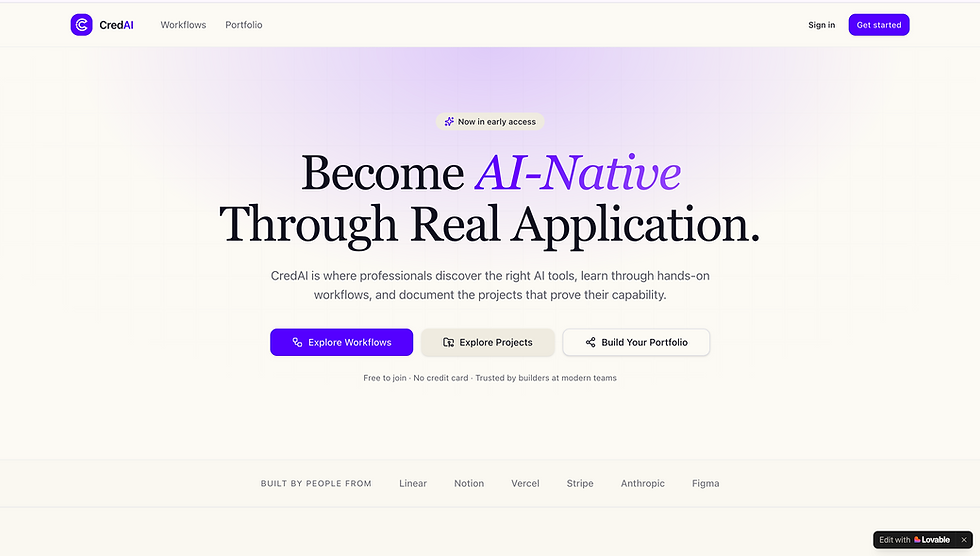
Image: CredAI website (made with Lovable)
Applications:
Startup ideation
Market mapping
Competitive analysis
Pitch development
Narrative positioning
Venture research
Interactive prototype building
AI-assisted product demos
Workflow visualisation
MVP landing pages
Projects & Concepts:
Lumeflo, AI healthcare operations platform
Cred, AI learning and portfolio-building platform for professionals exploring AI workflows and tooling
Interactive startup websites
Workflow demos and product prototypes
Primary Value: Rapid experimentation, accelerated product iteration, and reduced friction between strategy, design, and execution without traditional engineering bottlenecks.
Automation & Systems Design
Beyond prompting and product development, I 've found automation systems to improve operations workflows.
Using Make.com alongside tools like Slack, HubSpot, Salesforce, and Google Sheets, I explored how AI could reduce operational drag across recurring workflows.
I built lightweight systems for:
CRM syncing
automated reporting
founder pipeline tracking
and leadership oversight workflows
In one workflow, new operational data entered into Google Sheets automatically triggered summarised reporting outputs into Slack channels for stakeholder visibility. In another, LinkedIn contact information could be structured and routed directly into CRM systems to reduce manual entry friction.
AI becomes most powerful when integrated into workflows people already use every day.
AI Portfolio Snapshot - Automation Systems
Core Tools: Make.com, Slack, HubSpot, Salesforce, Google Sheets
Automations Built:
CRM syncing
Automated reporting pipelines
Founder tracking workflows
Operational update systems
Focus Area: Reducing repetitive operational overhead through lightweight automation systems.
Summary
Ultimately, this portfolio is less about AI tools themselves and more about how I think about execution.
What excites me most about AI is the shift it creates in how people can operate. The ability to research faster, prototype quicker, automate repetitive workflows, and iterate in real time fundamentally changes the pace at which ideas can move.
At the same time, working closely with these tools reinforced something that I've learned: AI does not replace judgment. If anything, it increases the value of critical thinking, synthesis, communication, and decision-making.
The tools continue to evolve rapidly. So does my workflow.
What remains constant is my curiosity about building better systems, improving execution quality, and exploring how AI can create leverage across research, operations, venture building, and product development.


Comments